

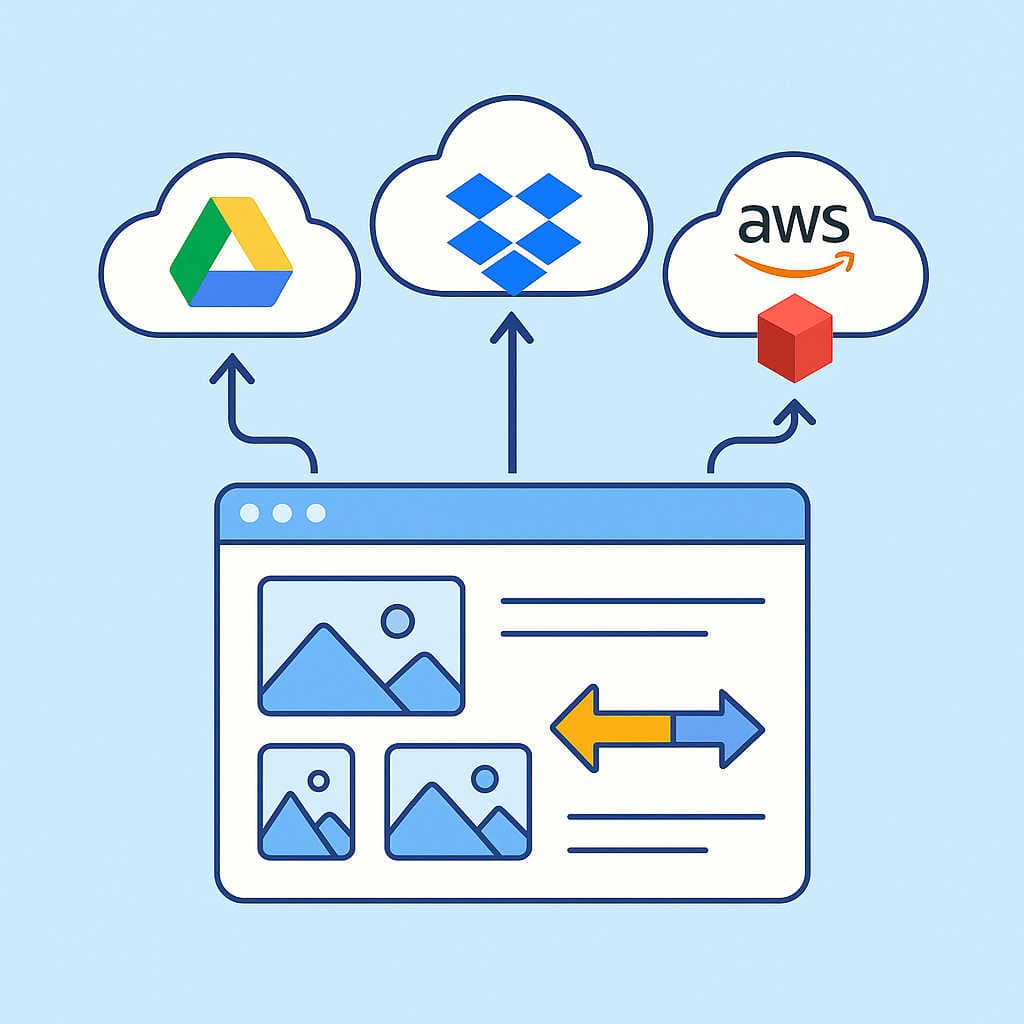
Google Drive vs Dropbox vs S3 for Screenshot Storage
If you’re automating website screenshots, storage isn’t just “where files go.” It controls how fast you can review changes, how safe your archives are, and how painless it is to scale from 100 captures to 50,000+ per month.
Here’s the short truth: when people ask “Which storage is best?”, they usually mean one of these:
Can your team open, comment, and share screenshots without friction?
Can you keep months of history, prove changes, and avoid accidental deletion?
What happens when you grow from 1,500 to 50,000 screenshots per month?
This guide is written for screenshot automation specifically: recurring schedules, lots of files, long retention, and stakeholders who want to find “that one screenshot from last month.” We’ll keep it practical, and we’ll tell you which choice is best for which kind of team.
What you’re really choosing
This isn’t a brand preference. It’s a workflow choice.
Think of your screenshot storage as the “operating system” for your monitoring. If you’re capturing pages for brand monitoring, competitor tracking, compliance, or web archiving, the files themselves are only half the value. The other half is the system around the files.
- How people discover the right image (folders, naming, search).
- How feedback happens (comments, sharing, approvals).
- How long history stays useful (retention, lifecycle rules).
- How safe it is (permissions, audit trails, backups).
- How it scales (limits, performance, cost predictability).
Here’s the biggest “aha”: your storage choice changes who is happy. If your users are marketers, founders, clients, or ops teammates who want to review screenshots like documents, Google Drive feels effortless. If your team values neat, consistent archives and heavy desktop usage, Dropbox can feel clean and reliable. If you’re running high volume capture pipelines, have retention policies, or want screenshots to feed internal tools, S3 becomes the long-term foundation.
The rest of this article helps you avoid the common trap: choosing storage based on marketing claims or “what your competitors use.” Instead, you’ll match storage to the exact way screenshots are used in your organization.
Quick picks (1 minute)
If you don’t want the full deep dive, use this.
Google Drive
Best for sharingPick Drive if screenshots are primarily reviewed by humans: clients, marketing, product, stakeholders. Drive wins on familiarity and friction-free sharing.
- • Easiest onboarding for non-technical users
- • Great link sharing and quick access
- • Works naturally with Google Workspace
Dropbox
Best for tidy archivesPick Dropbox if your team lives in folders, wants a long-term archive that stays readable, and benefits from desktop syncing and clean organization.
- • Great “folder culture” workflows
- • Strong team folder organization
- • Excellent for long-lived archives
S3
Best for scalePick S3 if you expect lots of files, strict retention, or you want screenshots to plug into pipelines. It’s the strongest long-term technical foundation.
- • Lifecycle rules, versioning, and policies
- • Handles huge counts without blinking
- • Designed for automation and integrations
Comparison table
A practical comparison for automated screenshot storage.
| Factor | Google Drive | Dropbox | S3 |
|---|---|---|---|
| Best at | Sharing + collaboration | Folder archives + sync | Scale + policies |
| Non-technical usability | Excellent | Very good | Low (needs setup) |
| Lifecycle automation | Limited | Moderate | Excellent |
| Access control granularity | Good | Good | Best-in-class |
| Handling huge file counts | Okay | Good | Excellent |
| Best workflow fit | Review & approvals | Ongoing archives | Pipelines / compliance |
The table is the “map.” Now we’ll explain the “terrain”: what the experience feels like day-to-day, what breaks at scale, and what choices save you time a month from now.
Google Drive
The smoothest option when screenshots are reviewed by humans.
Google Drive is the default winner for a simple reason: it’s the most familiar place where non-technical people already collaborate. If your screenshot workflow looks like “capture → review → share → approve,” Drive feels natural. People open a folder, scan thumbnails, click what they need, and share links in seconds. No special tooling. No training. No “engineering tickets” required.
Drive is especially strong when screenshots become part of a conversation. Stakeholders want to reference an image inside a doc, paste it into a presentation, or attach it to a task. Because Drive integrates with Workspace, the entire workflow stays inside the same ecosystem. That makes adoption fast—and adoption matters a lot more than most teams expect.
Where Drive shines
- Instant access for stakeholders: clients and teammates can browse folders without learning anything new.
- Sharing is effortless: view-only links and shared folders are familiar patterns for most organizations.
- Discovery is better than you think: Drive search helps when someone knows the domain or a date but not the folder.
- Great for review packs: weekly or monthly “review folders” work incredibly well in Drive.
Where Drive can hurt
- Huge folder performance: if you throw tens of thousands of images into one folder, browsing becomes slower and less pleasant.
- Permissions sprawl: as teams share folders over time, access control can become messy unless you standardize ownership.
- Retention policies are limited: Drive doesn’t give you S3-level lifecycle rules. You can manage retention, but it’s not as automatic.
If you want Drive to stay fast as volume grows, the trick is structure. You don’t need a complex hierarchy, but you do need a predictable one. A single “domain folder” strategy works well until the domain folder becomes huge. At that point, introducing a month subfolder is often enough to keep things snappy while preserving your naming scheme.
Dropbox
The best middle-ground: clean archives, strong folder workflows, reliable sync.
Dropbox tends to win when your team thinks in folders first. It’s not just “cloud storage”—it behaves like a stable, shared file system. That matters if your screenshot workflow includes offline review, desktop usage, or structured archives that need to remain readable over the long term.
For screenshot automation, Dropbox is often chosen by teams doing QA regression, compliance archiving, or internal monitoring where the archive is used repeatedly by the same group. The folder structure becomes “the product.” New teammates learn it quickly, and the archive remains understandable a year from now.
Where Dropbox shines
- Folder clarity: it’s easy to keep a stable archive structure that doesn’t get weird over time.
- Desktop-friendly workflows: teams that live in Finder/Explorer often prefer Dropbox.
- Great for long-lived archives: it stays readable, consistent, and easy to hand off.
Where Dropbox can hurt
- Not infinite-scale object storage: at extremely high volumes, S3 still wins on pure “lots of files” handling and lifecycle control.
- Client collaboration is good, but Drive is simpler: if your workflow is mostly approvals and sharing, Drive usually feels faster.
If you’re building a product that exports screenshots into customer storage, Dropbox is also a strong “default” because it doesn’t overwhelm users with configuration. It’s powerful enough for most use cases, while still being friendly for teams that want to browse and organize visually.
S3
The strongest foundation for scale, compliance, and automation.
S3-compatible object storage is designed for huge counts of files, strict access control, and automation. If you’re capturing screenshots at serious volume—or you want screenshots to feed downstream systems—an S3-compatible bucket is often the most flexible long-term choice. Website Screenshot World supports AWS S3 and other S3-compatible providers.
The thing that makes S3 powerful is also what makes it feel “harder”: S3 assumes you’ll define policies. Who can read? Who can write? How long do objects live? What happens after 30 days, 90 days, 365 days? Those questions can be answered precisely—and then enforced automatically.
Where S3 shines
- Lifecycle policies: move old files to cheaper classes, expire objects automatically, or keep versions for auditability.
- Programmatic access: APIs, pipelines, internal tools, and automation are first-class.
- Security controls: policies, roles, logging, and scoping are far more powerful than typical consumer storage.
- Scale without drama: S3 is built for millions of objects.
Where S3 can hurt
- Setup requires expertise: someone must configure the bucket, permissions, and lifecycle correctly.
- Browsing isn’t as “friendly”: Drive and Dropbox feel more natural for quick, human review unless you build UI on top.
- Costs can surprise you: not usually storage itself, but egress, requests, and “keep everything forever” habits.
A very common pattern is hybrid usage: S3 holds the long archive, and Drive holds lightweight “review packs.” That gives stakeholders a friendly review experience without giving up S3’s lifecycle and policy strengths.
Security & access control
Screenshots are often more sensitive than people expect.
Website screenshots can contain customer info, internal dashboards, pricing changes, or evidence of what a page looked like at a specific time. Even if you only capture public pages, the archive itself becomes valuable and sensitive because it proves history. That’s why access control deserves real thought—especially once you start sharing with clients or retaining files for months.
Strong enough for many teams. Biggest risk is permission sprawl over time. Prefer shared drives / groups and keep folder ownership consistent.
Practical team folder permissions and long-lived archives. Great when you want structure and stable access rules for a known team.
Strongest controls: IAM roles, bucket policies, logging, encryption choices, lifecycle enforcement. More work—best foundations.
A practical security checklist
- Define who is allowed to share links externally (especially in Drive).
- Keep a predictable structure so sensitive folders don’t get duplicated and shared in random places.
- Decide your retention upfront: “keep everything forever” should be a conscious policy, not an accident.
- For compliance-like needs, prefer S3 lifecycle rules (automatic expiration + versioning).
Cost & predictable billing
Your real cost is storage + overage behavior + team time.
Storage cost is rarely just “$ per GB.” In practice, your cost is shaped by behavior: how many captures you run, how long you keep history, whether users duplicate folders, and whether your archive becomes messy enough that people waste time searching.
The simplest way to keep costs predictable is to separate capture volume (screenshots/videos per month) from history (how long you keep them). That’s exactly how most sustainable screenshot products structure their plans.
How Website Screenshot World pricing maps to storage decisions
Your pricing model is built around monthly capture capacity + included history + clear overage pricing for extras and extended retention. See the pricing page.
| Plan | Extra screenshots | Extra videos | Extended history |
|---|---|---|---|
| Starter | $0.0055 | — | $0.015 / file / month |
| Pro | $0.005 | — | $0.014 / file / month |
| Advanced | $0.0045 | $0.0085 | $0.013 / file / month |
| Business | $0.004 | $0.008 | $0.012 / file / month |
This structure is great because it makes “keep everything forever” an explicit decision. If someone needs multi-year archives, pairing S3 lifecycle rules with a clear “extended history” cost keeps both the customer and the product happy.
Real-world workflows (and what storage fits best)
Pick the storage that matches how humans actually use your screenshots.
1) Agency / client approvals
You capture competitor pages daily. You share highlight folders weekly. Clients want access without extra logins or technical setup. The archive is part of your service.
- Drive-style links are frictionless for clients.
- Folders work well as “report packs.”
- Non-technical users don’t struggle.
2) QA regression tracking
You capture the same pages across environments (prod/staging) or across releases. Engineers, QA, and PMs want an archive organized by domain and date.
- Folder structure matters more than commenting.
- Teams often prefer desktop workflows.
- Consistency over time is key.
3) Compliance / proof / long archives
You must retain evidence. You need policies like “keep 90 days by default, keep 2 years for specific projects.” You want strict access and auditability.
- Retention should be automatic, not manual.
- Access needs to be scoped and logged.
- Large volume retention is common.
4) Engineering pipeline
Screenshots feed diffing tools, alerting, internal dashboards, or analysis jobs. You want reliable programmatic access and stable naming that pipelines can depend on.
- APIs and policies matter more than UI.
- Lifecycle rules protect cost at scale.
- One bucket can serve multiple downstream systems.
Recommended setups
If you want the lowest regret configuration, start here.
Setup A: Google Drive (matches your current sync)
- Root folder:
My Drive / WebsiteScreenshotWorld - One folder per domain:
… / {domain} - File naming (your current format):
{urlPath}_{yyyy-mm-dd-hh-mm}.{ext} - Example:
My Drive / WebsiteScreenshotWorld / silhouettec.com / https_www.silhouettec.com_2025-12-09-13-01.png
{yyyy-mm}) to keep browsing fast — but keep your current structure if it’s working.Setup B: Dropbox (folder-first archives)
- Keep a stable root:
Archives / WebsiteScreenshotWorld / {domain} - Optional month split for readability:
… / {yyyy-mm} / {urlPath}_{yyyy-mm-dd-hh-mm}.{ext} - Maintain consistent naming rules so new teammates can find history instantly.
Setup C: S3-compatible object storage (scale + compliance)
- One bucket per environment (prod vs staging) or per customer (if needed).
- Prefix structure (safe placeholders):
screenshots/{domain}/{yyyy}/{mm}/{dd}/... - Enable lifecycle rules: transition old files to cheaper storage classes; expire what you don’t need.
- Use IAM roles/policies scoped to only required prefixes.
Migration checklist
If you switch storage later, do it without breaking your workflow.
Most teams don’t migrate because they want to. They migrate because volume grows, access gets messy, or retention needs become real. The easiest way to migrate without chaos is to treat it as a workflow change, not a file copy.
Migration do’s
- Migrate the most-used data first (last 2–4 weeks). That’s where pain is felt.
- Keep the old archive read-only during migration to prevent duplicates and confusion.
- Document the new structure in one place (folder rules, naming, who owns it).
- If you move to S3, set lifecycle policies early so you don’t recreate the original problem.
Migration don’ts
- Don’t migrate everything at once unless you absolutely must.
- Don’t change naming rules mid-migration.
- Don’t let everyone “invent folders.” Pick an owner.
FAQ
Quick answers to what users ask right after they connect storage.
At low volume, the difference is usually small. At high volume, S3 often wins on raw storage cost—especially with lifecycle rules. But “cheap” also includes team time. If Drive saves hours of training and support, it may be cheaper in practice.
Not necessarily. Just ensure someone sets it up correctly. Many teams start with Drive/Dropbox and move to S3 once volume and compliance needs increase.
Most teams don’t. Keep what you need for your use-case and delete the rest. If someone truly needs long archives, S3 lifecycle rules can reduce storage costs— while “extended history per file / month” keeps billing predictable. See pricing.
Performance issues usually come from “too many files in one place.” A single folder with tens of thousands of images is unpleasant in most UIs. Splitting by domain (and optionally by month) keeps browsing fast without overcomplicating the archive.
Connect your storage and start capturing
Choose a plan based on monthly volume, then pick the storage that fits your workflow. You can start small and upgrade anytime. See pricing.